Solution-Focused Brief Hypnotherapy
Two Nights · Wednesday, October 21 & Thursday, October 22, 2026
8:00 PM – 9:45 PM Eastern Time Zone
Solutions-Focused Brief Hypnosis
Your Client Just Spent 40 Minutes Telling You How Bad It Is... And you still have no idea what to do next. Have you ever had that experience?
Clients who come back and leave a 5-star review are clients who found a solution in the first session.
This class will teach you how to give it to them!
You know the session. The ex. The boss. The childhood. The forty-year history of why they are the way they are.
You listen. You nod. You care, deeply.
And somewhere around minute thirty-five, a quiet thought surfaces: "None of this is helping them."
Because here's what nobody told you in your certification training: understanding a problem and solving a problem are two entirely different activities. You can map a client's pain in exquisite detail — and leave them exactly where they started. Only now they're tired, too.
Discover the techniques of running solution-focused rather than problem-focused hypnosis and coaching sessions in this 2-day training.
This Training Matters to You & Your Clients!
And it's all based on techniques with thousands of peer-reviewed journals showing they work!
Clients. People don't come back for a fourth session of describing their misery. They come back when something moves.
Referrals. Nobody tells a friend, "You should see my hypnotist — she really let me explain my problem thoroughly."
Income. Vague work produces vague results, and vague results can't be packaged, priced, or sold with confidence.
Energy. Sitting in someone's pain for sixty minutes with no structure for getting out of it is a leading path to burnout in this profession.
And here's the one that stings: somewhere in your own life, right now, there's a problem you've been analyzing for years instead of solving. You could write a dissertation on it. And it hasn't moved an inch.
You cannot lead a client somewhere you've never been yourself. This course will give you your own life solutions!

THE SOLUTION
What If You Never Had to Understand the Problem at All?
In the 1980s, at a clinic in Milwaukee, Steve de Shazer and Insoo Kim Berg sat behind a one-way mirror through thousands of hours of therapy, looking for what actually produced change.
What they found should have shaken the profession: you do not need to analyze a problem for a client to get better.
What they built from that discovery became Solution-Focused Brief Therapy — now one of the most heavily researched approaches in counseling.
But here's what almost nobody in the counseling world realizes.
The core techniques of SFBT are hypnotic techniques. Read them as a hypnotist and you'll see it instantly:
The Miracle Question is a guided age-progression induction — future pacing, vivid multi-sensory suggestion. De Shazer built it, but Erickson would have recognized it immediately.
Scaling questions are graduated suggestion structures — the same architecture as a hypnotic dial.
Exception-finding is direct suggestion delivered as a question, installing evidence of the client's competence beneath their resistance.
Presuppositional language — "When you notice the first small change…" — is textbook indirect suggestion.
SFBT spent forty years being validated by university research departments as a counseling approach.
It was hypnosis the whole time.

The Research, in Plain English
Research shows people improved by about 59%. A major 2024 review pooled 72 studies measuring nearly 500 outcomes. Participants receiving solution-focused work showed roughly a 59% improvement in the problems they came in with — and still came out about 32% better than people already receiving standard professional treatment.
And here's the finding that should stop every coach or hypnotist in their tracks. The biggest results did not come from people with clinical diagnoses. They came from ordinary people working on ordinary life problems — who improved substantially more than the clinical population did.
If you're a life coach, read that again. The best-supported population for this method is the exact population you already serve. That same review also found group delivery outperformed one-on-one — which means your group program just became your most powerful offer.
Research shows it works almost everywhere, and harms no one. An umbrella review examined 25 systematic reviews and 15 meta-analyses, finding consistently positive results across different problems, settings, and cultures, with no evidence of harm — with the highest confidence for depression, overall mental health, and progress toward a person's individual goals.
And it's fast. The literature describes positive effects after an average of four to six sessions. Not years.

Night One (all sessions are recorded)
Wednesday,
October 21, 2026
8:00 – 9:30 PM Eastern Time Zone
The Architecture of Change
Why problems and solutions are unrelated — the single idea that changes how you run every session for the rest of your career.
The Miracle Question, fully unpacked — exact wording, delivery, pacing, follow-up chain, and the four places most practitioners butcher it.
How to convert the Miracle Question into a formal hypnotic induction.
Exception-finding and scaling questions — building a client's belief in their own capability without ever arguing with them, and creating measurable, reportable progress.
Night Two
Thursday, October 22, 2026
8:00 – 9:30 PM Eastern Time Zone
Putting It to Work — In Your Life, Then in Theirs
Applying this to yourself, first — we'll do the work live, on your own stuck place. Not as a demo. As the actual point.
The complete session structure, open to close, so you never again walk in hoping something useful happens.
What to do with the client who insists on telling the whole story — the redirect that honors their pain without drowning in it.
Building a brief, premium 6-session package you can price and sell with total confidence.
Why We Start With You
Most continuing education asks you to learn a technique and go try it on a stranger. That's backwards.
The practitioners who get extraordinary results with this work are the ones who have felt it happen to them. When you've sat with your own miracle question — when you've watched your own thoroughly-analyzed problem suddenly reorganize itself around a possibility instead of a history — you deliver it differently forever after.
You stop performing a technique and start offering something you know is real.
There's a bonus nobody advertises, too: this work is lighter to deliver. You'll finish sessions with energy still in the tank.
WHAT YOU RECEIVE
Two live sessions — October 21 & 22, 8:00–9:45 PM Eastern
Unlimited 24/7 access to the full replay of both nights (can't make the date? Pre-register and get instant access to the replays!)
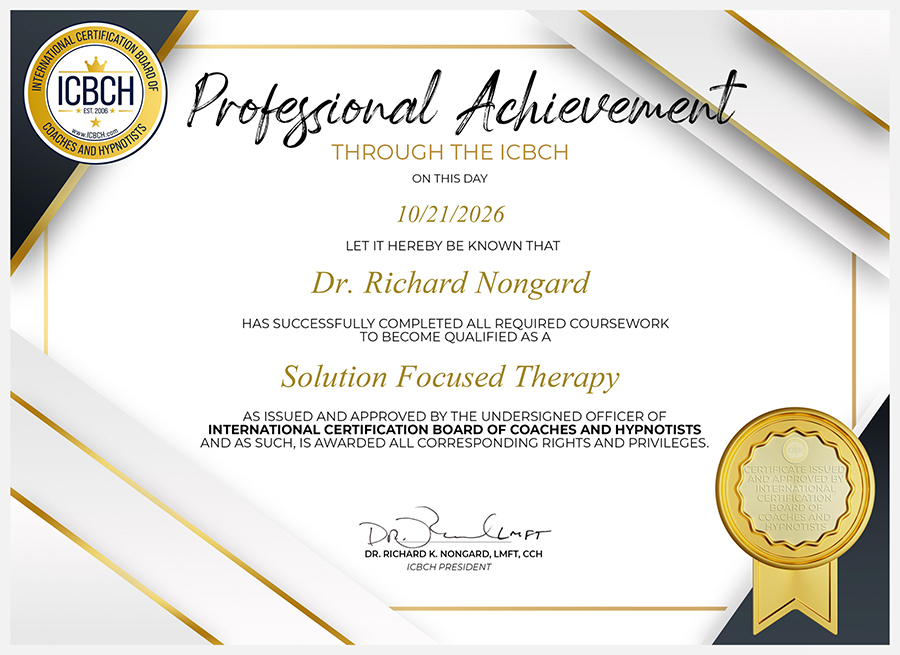
Printable ICBCH Certificate of Completion
Printable scripts — including the complete Miracle Question sequence
Printable client worksheets, resources, and scaling tools
Live Q&A both nights
Total investment: $89 for both nights. (Or $49x 2 payments)
One client. One package. And it's paid for itself many times over — then keeps paying, every week, for the rest of your career.
Can't Make One or Both Nights? Register Anyway.
Both nights are recorded. You receive full, unlimited 24/7 replay access — watch on your own schedule, from any device, as many times as you like.
Replay participants receive everything: the printable scripts, the client resources, and the same printable ICBCH Certificate of Completion. Nothing is held back.
Your $89 buys the training — not the hour.
About Your Instructor
Dr. Richard Nongard, Psy.D.
Can't attend live? Register anyway and get 24/7 replay access.
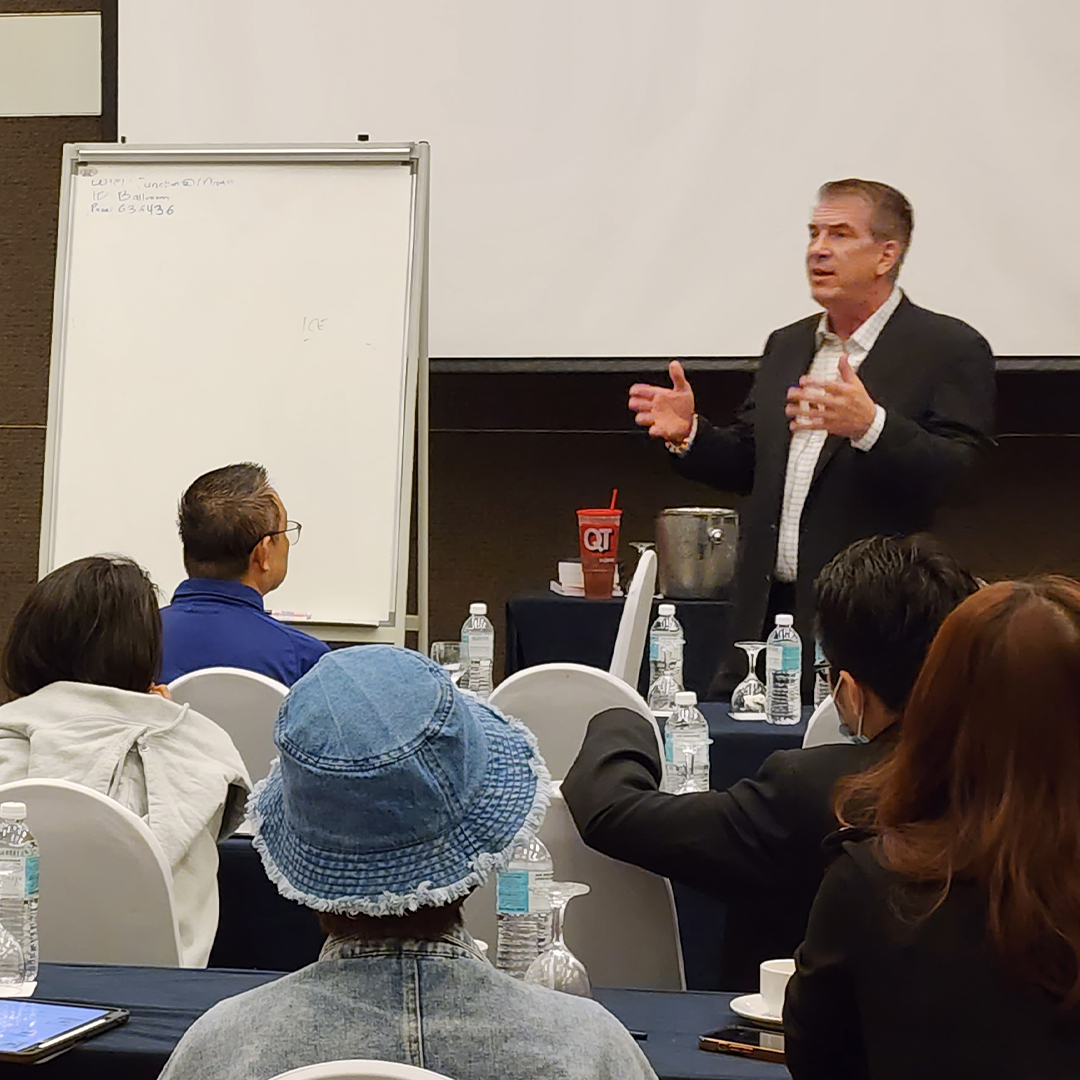
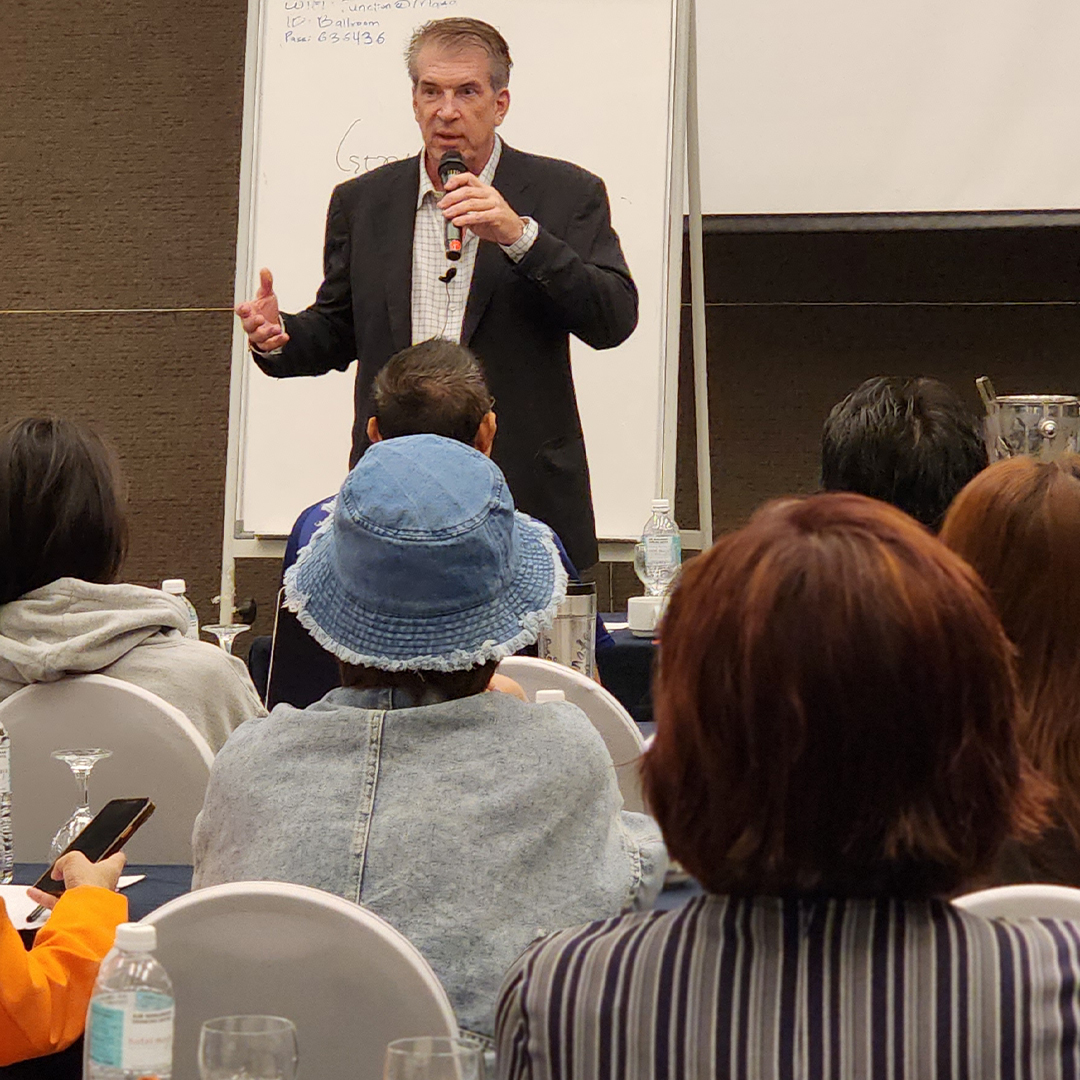
Hi — I'm Dr. Richard Nongard.
I've spent my career teaching clinical hypnosis to practitioners on six continents, and I've built my entire approach around one stubborn question: does it actually work?
Not does it sound impressive. Not does it demo well on stage. Does it work — and can the research back it up?
Solution-Focused Brief Therapy survives that question better than almost anything I've encountered in four decades of practice. And the more I worked with it, the more obvious it became that the counseling world had been sitting on a set of hypnotic tools without recognizing them for what they were.
I hold a doctorate in psychology (Psy.D.), I'm a Board Certified Professional Hypnotist and a Licensed Marriage and Family Therapist, and I train through the International Certification Board of Clinical Hypnotherapists (ICBCH).
But the credential that matters most for these two nights is different: I've used this on myself. On the decisions I'd analyzed to death. On the problems I understood perfectly and had never once solved.
That's why night two begins with your life, not your caseload.
— Dr. Richard Nongard, Psy.D.
There's a client on your calendar right now who's been stuck for years. They've told the story to a doctor. To a friend. Maybe to you.
They don't need to tell it again.
They need someone in the room who knows how to ask a different question.
October 21 & 22 · 8:00–9:45 PM Eastern · Online · $89 · Printable Scripts & Resources · ICBCH Certificate · Full Replay Access
References:
Vermeulen-Oskam, E., Franklin, C., van 't Hof, L.P.M., et al. (2024). The current evidence of solution-focused brief therapy: A meta-analysis of psychosocial outcomes and moderating factors. Clinical Psychology Review, 114, 102512.
Żak, A.M., & Pękala, K. (2024). Effectiveness of solution-focused brief therapy: An umbrella review of systematic reviews and meta-analyses. Psychotherapy Research, 35(7), 1043–1055.
Zhang, A., Franklin, C., Currin-McCulloch, J., Park, S., & Kim, J. (2018). The effectiveness of strength-based, solution-focused brief therapy in medical settings: A systematic review and meta-analysis of randomized controlled trials. Journal of Behavioral Medicine, 41(2), 139–151.
Individual results vary, and findings across the psychotherapy literature are not unanimous. Nothing in this training is presented as a cure or a guaranteed outcome. This workshop is professional education for practitioners; it is not therapy, not medical advice, and does not establish a treatment relationship. Practitioners should work within their scope of practice and applicable state or national law.
OptimizePress Popup Overlay
REGISTER NOW

Solution Focused Therapy
$89.00
WHAT YOU'LL LEARN
Night One
Wednesday,
October 21, 2026
8:00 – 9:30 PM Eastern Time Zone
The Architecture of Change
Why problems and solutions are unrelated — the single idea that changes how you run every session for the rest of your career.
The Miracle Question, fully unpacked — exact wording, delivery, pacing, follow-up chain, and the four places most practitioners butcher it.
How to convert the Miracle Question into a formal hypnotic induction.
Exception-finding and scaling questions — building a client's belief in their own capability without ever arguing with them, and creating measurable, reportable progress.
Night Two
Thursday,
October 22, 2026
8:00 – 9:30 PM Eastern Time Zone
Putting It to Work — In Your Life, Then in Theirs
Applying this to yourself, first — we'll do the work live, on your own stuck place. Not as a demo. As the actual point.
The complete session structure, open to close, so you never again walk in hoping something useful happens.
What to do with the client who insists on telling the whole story — the redirect that honors their pain without drowning in it.
Building a brief, premium 6-session package you can price and sell with total confidence.
OptimizePress Popup Overlay
REGISTER NOW
Solution Focused Therapy
$49.00
for 2 months!
WHAT YOU'LL LEARN
Night One
Wednesday,
October 21, 2026
8:00 – 9:30 PM Eastern Time Zone
The Architecture of Change
Why problems and solutions are unrelated — the single idea that changes how you run every session for the rest of your career.
The Miracle Question, fully unpacked — exact wording, delivery, pacing, follow-up chain, and the four places most practitioners butcher it.
How to convert the Miracle Question into a formal hypnotic induction.
Exception-finding and scaling questions — building a client's belief in their own capability without ever arguing with them, and creating measurable, reportable progress.
Night Two
Thursday,
October 22, 2026
8:00 – 9:30 PM Eastern Time Zone
Putting It to Work — In Your Life, Then in Theirs
Applying this to yourself, first — we'll do the work live, on your own stuck place. Not as a demo. As the actual point.
The complete session structure, open to close, so you never again walk in hoping something useful happens.
What to do with the client who insists on telling the whole story — the redirect that honors their pain without drowning in it.
Building a brief, premium 6-session package you can price and sell with total confidence.