The Art of Making Suggestion Irresistible – Mastering the Hypnotic Language Patterns of Alan Watts
A Two-Day Live Intensive with Dr. Richard Nongard
November 12, 2026 • 08:00 AM Eastern Time
He was not a hypnotist. He was one of the most hypnotic speakers of the twentieth century. This is the class where I take his method apart and hand it to you so you can create iressistable suggestions in your hypnosis sessions!
Live both days • Lifetime recordings • ICBCH Certificate of Completion • Downloadable pattern guide, scripts, and voice exercises
Some People Can Say a Thing and It Lands.
You have watched this happen.
A client sits in your chair. You deliver a perfectly good suggestion. Technically correct. Well constructed. Everything your training told you to do.
And it goes in about four inches and stops.
Then someone else says nearly the same thing, in different words, and the client's face changes. Something drops. They go quiet in that particular way. And six weeks later they are still quoting it back to you.
Same idea. Different delivery. Completely different result.
That difference is not charisma, and it is not luck. It is structure. It is metaphor selection, sentence rhythm, cadence, pacing, pitch, pause, and the way a person frames an idea so the listener does not have to defend against it.
November 12, 2026 • 08:00 AM Eastern Time • Recordings and certificate included
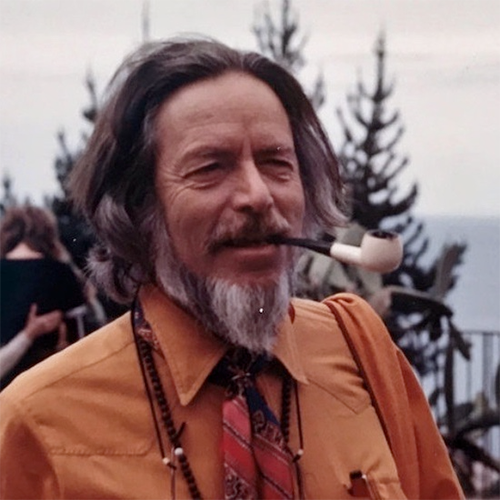
Alan Watts did this better than almost anyone who ever held a microphone. And unlike charisma, what he did can be identified, broken down, and used.
That is what these two days are.
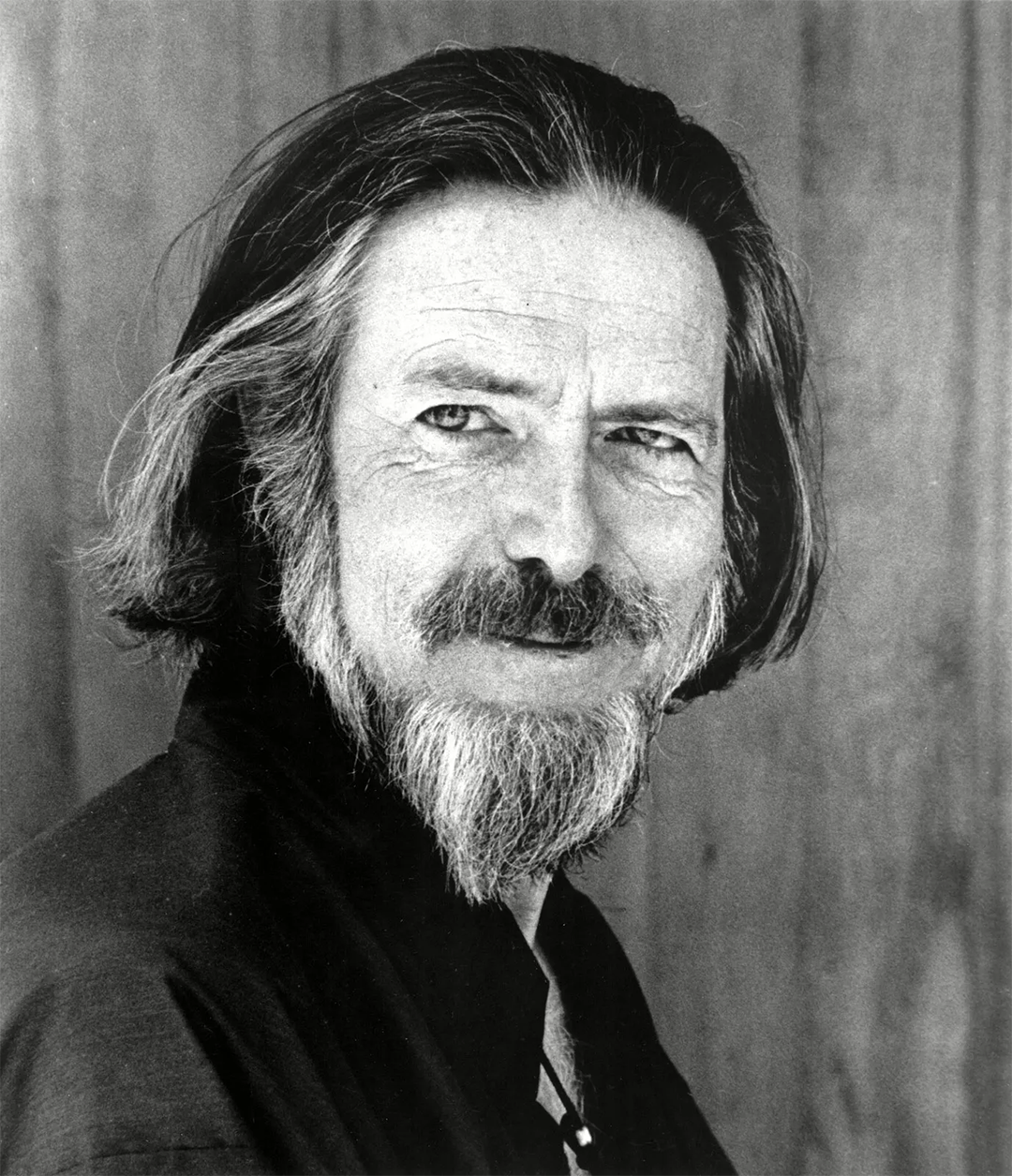
If the name is new to you, here is the short version.
Alan Watts was born in England in 1915 and moved to the United States in 1938. He trained as a theologian, was ordained an Episcopal priest in 1945, served as a chaplain at Northwestern University, and walked away from the ministry by 1950.
He moved to California, joined the faculty of the American Academy of Asian Studies in San Francisco, and spent the rest of his life doing one thing extraordinarily well: taking ideas Western people found impenetrable and making them land.
Zen. Taoism. Hinduism. Buddhism. Ideas that had been locked inside scholarly translation and monastic vocabulary, and that most Westerners bounced straight off of.
He wrote more than twenty-five books. The Way of Zen, published in 1957, became one of the first genuinely bestselling books on Eastern thought in the English language. He broadcast for years on Pacifica Radio in the Bay Area, taught on public television, and toured universities through the 1960s and early 70s. He died in 1973.
And then something happened that almost never happens.
His recordings did not fade. They spread. Decades after his death, his talks are on YouTube with tens of millions of views. They are layered under music, cut into short videos, and played by people who could not tell you a single thing about Eastern Philosophy but who will stop scrolling and listen to the whole thing.
Ask yourself the practitioner's question about that.
Why does a lecture recorded on reel-to-reel in 1965, by a man discussing Taoist metaphysics, hold the attention of a nineteen-year-old in 2026 better than almost anything else on the internet?
It is not the content. Plenty of people teach that content.
It is the delivery. And delivery is this entire profession!
WHY THIS MATTERS TO A HYPNOTIST
Here is the thing that makes Watts worth two full days of your time.
Watts had exactly the problem you have.
He needed to communicate something the listener's conscious, analytical, defended mind was structurally unable to accept. He could not argue people into it, because argument invites counterargument. He could not command it, because nobody takes orders about their own inner life. He could not explain it directly, because the explanation was the very thing the intellect would seize and neutralize.
That is your job description. Every single session.
So he did what Milton Erickson did, in a completely different field, for completely different reasons, and without either man borrowing from the other.
He developed a set of repeatable linguistic structures for getting an idea past the guard.
Metaphor that does the work before the listener realizes work is being done. Questions that presuppose their own answers. Invitations to suppose rather than demands to believe. Paradox that stalls the analytical mind just long enough. Concrete, physical, sensory images standing in for abstractions. Rhythm that entrains. Humor that opens. And a voice that made people lean in.
Read a transcript of a Watts talk as a hypnotist, with a pattern-spotting eye, and you will find yourself underlining nearly every paragraph.
That is exactly what happens in this class, for two days, and you walk out able to use it.


WHAT THIS DOES TO YOUR SUGGESTIONS
Most hypnotic suggestion fails in one of three ways. Watts solved all three.
It is abstract, so it has nothing to hold onto. "You feel confident." Confident how? In what body? Doing what? Vague suggestion produces vague results. Watts never left an idea abstract for more than a sentence. He immediately converted it into something physical and specific you could see, feel, and picture. You will learn how he made that conversion, and how to do it live, in session, without a script.
It is not actionable, so nothing changes on Monday. Insight is not behavior. Watts had a gift for taking an enormous philosophical idea and landing it as something you could actually do differently the next morning. That skill turns a nice session into a client who comes back and says the thing worked.
It is boring, so nobody remembers it. This is the one nobody in this field wants to talk about. A large amount of hypnotic scripting is beige. Safe, generic, forgettable language delivered in a flat voice. Watts was entertaining. He called himself a philosophical entertainer and he meant it. He was funny. He was surprising. He enjoyed himself out loud, and the listener enjoyed it with him.
Suggestion that delights a client is suggestion that gets repeated in their own head for weeks. That is free reinforcement, and it is the closest thing to a growth engine this profession has.
THE IDEAS, THE METAPHORS, AND THE TRUTHS
November 12, 2026 | 8:00 AM Eastern Time
The material. The core Watts concepts that translate directly into clinical work, and the metaphors he built to carry them.
These are not philosophy-class abstractions. Each one maps onto a presenting problem you already see every week.
And throughout day one: how to lift a metaphor cleanly. You will learn to take the structure of a Watts metaphor and rebuild it with content drawn from your specific client's life, which is what makes it land rather than sounding like something you read in a book.
You also get the boundaries. Where this material is contraindicated, which clients should not be handed a dissolve-the-self metaphor, how to keep philosophical content inside your scope of practice, and how to teach an idea without preaching a religion.

THE HYPNOTIC VOICE
Then comes the part most classes skip entirely.
Watts had a voice people describe as hypnotic before they know anything about hypnosis. And it was not simply that he was British.
It was cadence. Rhythm. The unhurried tempo. The downward inflection that signals certainty and closes a phrase. The pause held a half beat longer than a normal speaker would dare. The drop in pitch on the line that matters. The willingness to slow down precisely where a nervous speaker speeds up. The variation between the long flowing sentence and the short landing.
Your voice gets worked on directly:
One thing this class does not do: teach you to impersonate Alan Watts. Nobody needs your British accent. This is about extracting transferable mechanics and putting them into your voice, with your own personality fully intact. The patterns work in an Ohio accent. They work in a Filipino accent. They work in yours.
WHAT THIS DOES FOR YOUR PRACTICE
Your suggestions get sticky. Clients repeat memorable language to themselves between sessions. That is reinforcement you are not present for and do not have to bill for.
Your sessions get more interesting to deliver. Reading the same script for the nine hundredth time is how good hypnotists quietly burn out. Improvising fresh metaphor from a structure you actually understand is how the work stays alive.
You differentiate instantly. Everyone in your market offers the same services in the same beige language. Nobody else in your town sounds like this.
You reach an audience through the door Watts already opened. There are millions of people who found these ideas through a short video and now want something deeper and more personal. They are not looking for a hypnotist. They would absolutely book one who speaks their language.
Your reviews change. People do not write memorable reviews about a technically competent session. They write them about something a practitioner said that they have not stopped thinking about.
AND HONESTLY, THIS IS GOING TO BE FUN
I will be straight with you about why I am teaching this one.
Most continuing education in this field is necessary and a little joyless. Protocols, contraindications, documentation. Important. Not exactly a good time.
This is two days of listening to a brilliant, funny, slightly mischievous man talk about being alive, and then taking his method apart like a watch to see what makes it tick.
You will laugh. You will get ideas you want to use immediately. You will find yourself talking differently by the afternoon of day one, and you will notice it happening.
It is the most enjoyable class I teach, and I am not going to pretend otherwise in order to sound more clinical.
EVERYTHING YOU GET WHEN YOU REGISTER
I will be straight with you about why I am teaching this one.
Most continuing education in this field is necessary and a little joyless. Protocols, contraindications, documentation. Important. Not exactly a good time.
This is two days of listening to a brilliant, funny, slightly mischievous man talk about being alive, and then taking his method apart like a watch to see what makes it tick.
You will laugh. You will get ideas you want to use immediately. You will find yourself talking differently by the afternoon of day one, and you will notice it happening.
It is the most enjoyable class I teach, and I am not going to pretend otherwise in order to sound more clinical.
This is the difference between leaving a class inspired and leaving a class equipped.
ABOUT DR. RICHARD NONGARD
I am a licensed psychotherapist, a Certified Professional Hypnotist, and the author of more than thirty books on hypnosis, clinical technique, and personal change.
I have spent thirty years teaching evidence-based hypnosis to practitioners in more than fifty countries, and I direct the International Certification Board of Clinical Hypnotherapy. I have trained hypnotists, coaches, therapists, and physicians, and I still see clients myself, which is the part that keeps the teaching honest.
I teach from what works in the room, not from theory.
Live instruction both days. Lifetime access to the recordings. Your ICBCH Certificate of Completion. Downloadable notes, the full pattern guide, metaphor templates, voice exercises, and sample scripts.
Register now, while it is in front of you. Your next client is going to hear whatever language you happen to have available in the moment. Two days from now, that could be a great deal more than it is today.
A NOTE FROM ME
I am the first person to tell you that technique matters and that we should be careful about what we claim.
I will also tell you this. In thirty years of doing this work, I have never once seen a client changed by a suggestion that was technically correct and emotionally dead.
The words matter. The images matter. The rhythm matters. The voice matters. Delivery gets treated as decoration on top of the real work, and it is not decoration. In this profession, delivery is the intervention.
Alan Watts understood that as well as anyone who ever lived, and he left behind hundreds of hours of recorded evidence to study. He was not trying to teach hypnotists anything. He did it anyway.
Two days. Come and get it.
RESERVE YOUR SEAT
The Hypnotic Language of Alan Watts: Metaphor, Cadence, and the Art of Making Suggestion Irresistible
Date:
11/12/2006
Time:
8:00 AM Eastern Time
OptimizePress Popup Overlay
REGISTER AND JOIN US!

The Art of Making Suggestion Irresistible – Mastering the Hypnotic Language Patterns of Alan Watts
$97.00
WHO WAS ALAN WATTS?
If the name is new to you, here is the short version.
Alan Watts was born in England in 1915 and moved to the United States in 1938. He trained as a theologian, was ordained an Episcopal priest in 1945, served as a chaplain at Northwestern University, and walked away from the ministry by 1950.
He moved to California, joined the faculty of the American Academy of Asian Studies in San Francisco, and spent the rest of his life doing one thing extraordinarily well: taking ideas Western people found impenetrable and making them land.
Zen. Taoism. Hinduism. Buddhism. Ideas that had been locked inside scholarly translation and monastic vocabulary, and that most Westerners bounced straight off of.
He wrote more than twenty-five books. The Way of Zen, published in 1957, became one of the first genuinely bestselling books on Eastern thought in the English language. He broadcast for years on Pacifica Radio in the Bay Area, taught on public television, and toured universities through the 1960s and early 70s. He died in 1973.
And then something happened that almost never happens.
His recordings did not fade. They spread. Decades after his death, his talks are on YouTube with tens of millions of views. They are layered under music, cut into short videos, and played by people who could not tell you a single thing about Eastern Philosophy but who will stop scrolling and listen to the whole thing.
Ask yourself the practitioner's question about that.
Why does a lecture recorded on reel-to-reel in 1965, by a man discussing Taoist metaphysics, hold the attention of a nineteen-year-old in 2026 better than almost anything else on the internet?
It is not the content. Plenty of people teach that content.
It is the delivery. And delivery is this entire profession!
OptimizePress Popup Overlay
REGISTER AND JOIN US!
The Art of Making Suggestion Irresistible – Mastering the Hypnotic Language Patterns of Alan Watts
$49.00
FOR 2 MONTHS
WHO WAS ALAN WATTS?
If the name is new to you, here is the short version.
Alan Watts was born in England in 1915 and moved to the United States in 1938. He trained as a theologian, was ordained an Episcopal priest in 1945, served as a chaplain at Northwestern University, and walked away from the ministry by 1950.
He moved to California, joined the faculty of the American Academy of Asian Studies in San Francisco, and spent the rest of his life doing one thing extraordinarily well: taking ideas Western people found impenetrable and making them land.
Zen. Taoism. Hinduism. Buddhism. Ideas that had been locked inside scholarly translation and monastic vocabulary, and that most Westerners bounced straight off of.
He wrote more than twenty-five books. The Way of Zen, published in 1957, became one of the first genuinely bestselling books on Eastern thought in the English language. He broadcast for years on Pacifica Radio in the Bay Area, taught on public television, and toured universities through the 1960s and early 70s. He died in 1973.
And then something happened that almost never happens.
His recordings did not fade. They spread. Decades after his death, his talks are on YouTube with tens of millions of views. They are layered under music, cut into short videos, and played by people who could not tell you a single thing about Eastern Philosophy but who will stop scrolling and listen to the whole thing.
Ask yourself the practitioner's question about that.
Why does a lecture recorded on reel-to-reel in 1965, by a man discussing Taoist metaphysics, hold the attention of a nineteen-year-old in 2026 better than almost anything else on the internet?
It is not the content. Plenty of people teach that content.
It is the delivery. And delivery is this entire profession!